Your head has a pillow. Where is your arm supposed to go?
7 reasons to rethink your pillow’s shape before buying another one that only feels different.
You lie down, ready to switch off. Then the adjusting starts.
Arm under the pillow. Arm back out. Fold the corner. Roll over. Try again.
You don’t want a more complicated bedtime routine. You want to settle onto your side, find a comfortable place for your arm, and stop thinking about your pillow.
So before you buy another soft, firm, fluffy or contoured option, ask a different question:
Does this pillow leave room for the way I actually sleep?
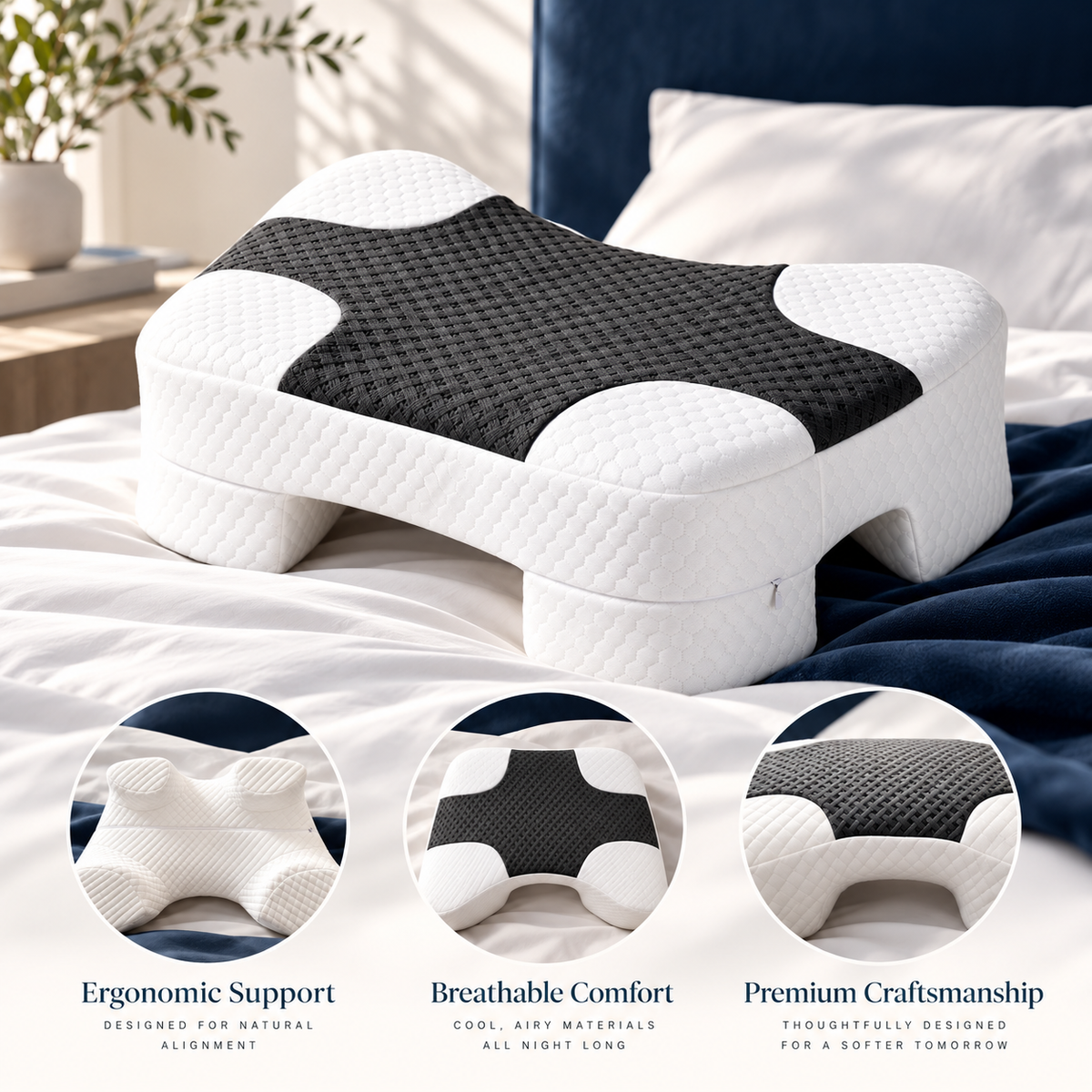
Nester DreamPillow® V.2 combines side openings for your arm with a raised, contoured surface for your head and neck. Here’s why that difference deserves a closer look.
Getting comfortable shouldn’t mean finding somewhere to hide your arm.

You know where your head goes. Your arm is another story.
If you like sleeping with an arm under or beside your pillow, a solid cushion can leave you working around it: tucking, shifting, and searching for a spot that feels right.
DreamPillow gives your arm a dedicated opening. It creates space within the pillow’s shape while the surrounding surface supports your head and neck.
The goal is simple: somewhere for your arm to rest, without having to keep rearranging everything around it.
Softer or firmer doesn’t answer every comfort problem.

Perhaps you’ve already tried changing the feel. A softer pillow. A firmer one. Another layer underneath.
Those changes can affect comfort. But if what you’re missing is space for your arm, changing the filling alone doesn’t necessarily give you that space.
That’s the distinction worth looking at here. DreamPillow changes the shape around your arm as well as the surface beneath your head.
You’re comparing a different layout for your sleeping position, not simply another promise of “premium softness.”
You shouldn’t have to fold your pillow into the shape you need.
A folded corner. A hand underneath. Two pillows stacked together, then one pulled away.
When you’re trying to find a comfortable height, it’s easy to turn bedtime into a small construction project.
DreamPillow’s elevated, contoured form is built into its memory-foam core. The shape provides a resting surface for your head and neck alongside the arm opening.
Instead of making a flat pillow into something else, you can try a shape designed around that combination. Your mattress and preferred sleeping position still matter, so compare the dimensions before choosing.
You can turn over without giving up the arm opening.
“But I don’t stay on one side all night.”
You don’t need to commit to a favourite side to understand this design. DreamPillow has an opening on each side, so the space for your arm isn’t limited to one direction.
If you also spend time on your back, you can turn the pillow around and explore its contoured surface.
Choose the position that feels comfortable to you. There’s no need to force yourself into a new sleep habit just because a product photo shows someone sleeping that way.
Support should still feel inviting when you put your cheek down.

A clever shape isn’t enough. You have to want to sleep on it.
The DreamCover provides a soft, breathable surface over the memory-foam core. Together, they give you the fabric feel and the shaped support to consider—not just a choice between “soft” and “firm.”
Picture the part of bedtime you actually want: lights off, head down, arm resting comfortably. That is the experience the design is built around.
If you have fabric sensitivities, check the material details on the product page before ordering.
The everyday details should make ownership easier, too.
It’s fair to ask what happens after the first night.
DreamPillow’s cover unzips and comes off, so you can care for the part you sleep against separately from the core. Follow the care instructions for each part rather than treating the whole pillow as one washable cushion.
And before you order, check the practical details: the size, materials, care guidance and delivery information.
A pillow becomes part of your nightly routine. It should make sense for your routine as well as look good on your bed.
You deserve more than another “perfect for everyone” promise.
“I’ve bought pillows before. How do I know this one will suit me?”
That’s a reasonable question. No picture or headline can guarantee how a pillow will feel on your mattress, in your preferred position.
What you can assess is the difference in the design: openings for your arm, a contoured memory-foam core, and a removable cover. You can see those features and decide whether they address what frustrates you about your current pillow.
Check the current return policy before buying, including the eligibility requirements and how to request a return.
If the nightly shuffle starts with “where do I put my arm?”, this is the part of DreamPillow worth exploring next.
See what changes when your arm has its own space.
If you recognised your own bedtime routine in this page, take a closer look at DreamPillow® V.2.
See the pillow from every angle, review the materials and dimensions, and compare the current single-pillow and bundle options. You’ll find the details you need to decide whether it belongs on your bed.